By Mandela Oguche and Linet Okoth, Intervention team
“There is a myth that community health workers cannot understand Quality Improvement (QI) concepts. We have busted that myth with the Du-it Community–Facility QI Model.”
For a long time, Quality Improvement (QI) was viewed as a technical process meant only for senior health managers and facility professionals. However, through the Du-it Community–Facility QI Model, tested within antenatal and maternal health services under the C-it Du-it project, we have learned that when community health workers (CHWs) are trained, guided, and supported, they not only understand QI — they excel at it.
This is a unique, first-of-its-kind approach that brings communities and facilities together in the same QI team. The model has transformed the way health facilities and communities collaborate to improve maternal and newborn health outcomes.
A Step-by-Step Learning Approach
A key feature of the Du-it model is its facilitated training process, designed to simplify complex QI concepts into practical, hands-on learning experiences. The training unfolds in three phases:
- Phase One: Short, focused training sessions introducing key QI concepts and tools.
- Phase Two: Practical sessions, where participants apply what they have learned directly in their work settings to solve real problems.
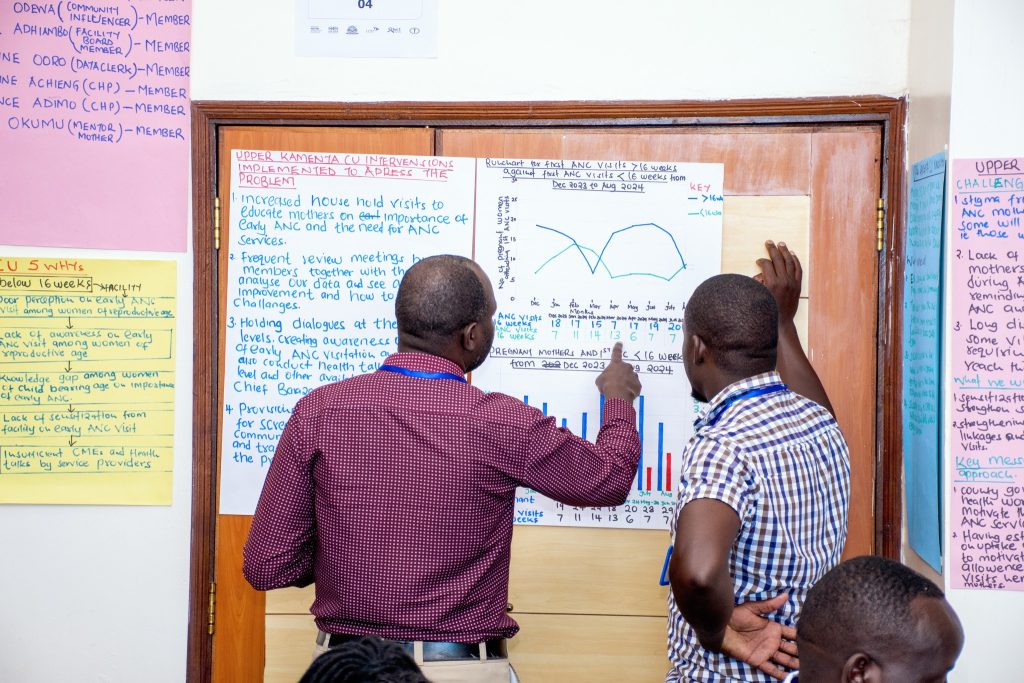
- Phase Three: Experience-sharing sessions, where teams reflect on what worked, what didn’t, and how they can adapt. Each QI cycle concludes with a Learning Event – a “festival of learning” – where community and facility teams showcase their progress, share innovations, and celebrate results.
As Lvcthealth, we have started implementing the Du-it model in Kenya since 2016. This iterative process has allowed teams using the Du-it model to continually adapt and expand, applying QI to a variety of maternal and child health interventions. This continuous cycle of learning has kept the model dynamic and responsive.
Who Makes Up the Work Improvement Team
Each Work Improvement Team (WIT) includes:
- Community health providers
- Community health supervisors
- The facility in charge
- A community representative
- Representative from community administration
- A member of a vulnerable group — for instance, an adolescent in the adolescent-friendly service WIT
This inclusive composition guarantees that diverse voices are heard and that solutions are guided by authentic community experiences. Through this structure, teams have learned to collect, understand, and analyze their own data — identifying issues affecting antenatal care, setting priorities, and developing interventions to address them.
One innovative solution that emerged in Homabay is the locator form. Initially, one facility struggled to match community health providers with the specific villages they served due to local naming differences. The locator form simplified this process by linking each provider to their community, improving home visits, follow-ups, and referrals — a simple but powerful innovation born from local insight.
The Du-it model is implemented and tested under the C-it Du-it study, funded by NIHR, to strengthen community-facility collaboration in improving antenatal care quality in Homa Bay County.
Data That Drives Action
By linking community-level data (eCHIS) with facility-level data (EMR), the Du-it model provides a complete picture of a mother’s journey — from identification in the community to care at the facility. This linkage enhances follow-up, reduces missed visits, and ensures continuity of care.
A recent study at a Homa Bay health facility revealed that 78.6% of ANC clients had missed at least one appointment, citing long distances and waiting times as the main barriers. Findings like these highlights why community–facility collaboration and data integration are essential to improve service access and quality.
Lessons for Counties and Sub-Counties
From the Du-it model, several key lessons stand out:
- Empower CHWs as part of QI teams — they are closest to the community and vital for identifying early challenges.
- Strengthen data integration between eCHIS and EMR systems for real-time decision-making.
- Encourage joint planning and reflection sessions where facility and community teams co-design solutions.
- Allocate county resources to sustain community–facility QI structures. Quality improvement should be institutionalized, not treated as a one-time project.
When communities and facilities work together, every mother and baby benefits. The Du-it model proves that QI is not about complicated tools — it’s about people coming together, building trust, learning continuously, and using data to drive action.
A Shared Responsibility
County and national policymakers, together with funders, have a vital role to play by embedding community-facility QI structures within routine maternal health systems, investing in adolescent-friendly antenatal care, and ensuring that SHA resources reach the girls and mothers who need them most.
Together, we can bridge the gap — one mother, one community, and one facility at a time.