This past week was truly impactful for me, thanks to the C-it DU-it 2nd Learning event organized by LVCT Health in Homa bay.
It was my first time learning about LVCT Health and the incredible work the organization is doing to strengthen community health systems. Their impact in Homa bay is nothing short of inspiring, and I knew I wanted to experience it firsthand.
As a medical student, we’re taught that pregnant women should attend at least 8 antenatal care (ANC) visits, as recommended by WHO. On paper, this seems straight-forward and attainable but in reality various social, economic, and logistical challenges prevent many women from accessing these services.
I was impressed to see how LVCT health is bridging this gap through community Health Promoters (CHPs); bringing care closer to the people and truly making every contact count!
One initiative that really stood out to me was from a CHP who created a WhatsApp group for pregnant women in the same trimester. This simple but powerful idea not only builds a sense of community, encourages peer learning but also motivates mothers to attend their ANC visits consistently.
As someone passionate about Sexual and Reproductive Health and Rights (SRHR),I deeply admired the team working with pregnant adolescents. I appreciate how they approach this issue head-on; creating safe spaces where young mothers receive guidance, education and emotional support as they prepare for motherhood. That level of care and respect is something I truly value.
Although the learning event lasted just two days, it was incredibly eye-opening. It gave me real-world context to what we learn in the classrooms and the hospitals, helping me understand the journey of care long before a patient reaches a facility.
I’m deeply grateful to LVCT Health for this opportunity. I look forward to more such learning experiences and to seeing the continued impact of C-it Du-it in improving maternal health outcomes in our communities.
Truly, I love this for our mothers.
Thank you, LVCT Health. ❤
By Cellestine Ngichu
Medical student and C-it Du-it learning event participant.
“It was raining so hard, and I had no way to reach the hospital,” recalls Atieno*. Naomi’s* story echoes hers: “It was late at night, and I couldn’t find a motorbike. The roads were flooded, and no one was around to help.”
These are not singular occurrences. They represent the prevailing reality for many women in Homa Bay County, where giving birth outside a health facility is reality rather than the exception. Across the County, too many women still deliver outside health facilities, not out of choice, but because systems designed to protect them are failing.
Unskilled deliveries are widely recognized as a contributor to maternal and neonatal complications and a reminder that policy gaps can have life-and-death consequences. The C-IT DU-IT study (Community Data Use for Integrated Antenatal Care) amplifies the voices of pregnant women and mothers to better understand the barriers and challenges they face in accessing skilled delivery.
Why So Many Women Deliver at Home?
Night-time Deliveries and Transport Challenges
Many testimonials highlighted the frequent commencement of labour during the night, often compounded by lack of transportation. Mothers recalled instances of heavy rain and impassable roads, illustrating the urgent need for improved rural infrastructure and reliable night-time transit options. Atieno* recalls “It was heavily raining and I had no means to reach the hospital.” While for Naomi* “It was late at night, and I couldn’t find a motorbike. It was raining heavily, the roads were bad, and transport wasn’t available.’’ In rural areas, poor roads, insecurity, and the high cost of transport at night leave many women with no option but to deliver at home.
“The nearest facility was closed at night, so I went back home.”“On my way to the facility I was told it was closed, then I decided to go to a traditional birth attendant.”“Nurses were on strike, so I went back home where I delivered,” Recall from three mothers. Even when women attempt to reach health facilities, access is not always guaranteed. Closed health facilities and disrupted services, sometimes due to industrial actions like strikes, further emphasize the gap between healthcare availability and need. These gaps reinforce home deliveries and traditional birth attendants. The narratives highlight an area ripe for policy intervention—ensuring round-the-clock operation and resource availability in health centers, especially in rural locales.
Sudden and Unpredictable Labor
Abrupt onset of labor also emerged as a recurring reason for home delivery. For some mothers, the duration between labor pains and delivery was too short to allow travel. “The pain came abruptly and within minutes I delivered,” one woman said. “I delivered before reaching the health centre,” another recalled. Some mothers admitted to not recognizing early labor signs: “I didn’t know it was labor, it caught me unaware.” These experiences highlight the importance of antenatal education on early signs of labor and birth preparedness planning.
Lack of Support and Companionship
Social support is critical during childbirth, yet many mothers reported being alone when labor began. “I was alone at home at the time of labor,” one explained. Another noted, “My spouse was not around when labor kicked in.” The absence of a birth companion or partner often prevented women from seeking care in time, particularly at night.
Financial Barriers
Despite the official provision of free maternal services in Kenya, hidden costs and a fear of out-of-pocket expenses deter many from seeking skilled care. A mother explained, “I was not registered to SHA, so I feared I wouldn’t afford the delivery fee.” Another admitted, “I didn’t have health insurance.” These financial concerns, combined with transport costs, contribute significantly to delays in seeking skilled care.
Implications for Maternal Health
These shared experiences underscore that unskilled deliveries often result from systemic and socioeconomic barriers, rather than personal choice. These circumstances significantly increase the risks associated with home-based deliveries, including complications, miscarriages, and maternal and neonatal mortality.
Service Availability: Ensure every facility operates 24/7, with trained staff and reliable power and supplies.
Transport and Referral Improvements: Invest in rural transport and referral including ambulances and all-weather roads.
Health insurance: Expand health insurance coverage and eliminate hidden costs that deter care.
Strengthen Community-Based Emergency Responses: Every village should have a plan for safe delivery.
Education and Support: Advocating for antenatal education and involving families in maternal health planning
A shared responsibility
The women of Homa Bay have spoken clearly. Their voices are data and testimony revealing that unskilled deliveries are not mere oversights but reflect larger systemic inadequacies and day-to-day challenges. By carefully considering their experiences and addressing the barriers they face, stakeholders can collaboratively work towards encouraging safer deliveries within healthcare facilities.
Because every mother deserves the chance to give life safely not as a privilege, but as a fundamental right.
*Names changed for confidentiality purposes
written by; JOHNBOSCO OMASAJA, Clinical Officer & Research Officer at KEMR
When I first approached Gerald with a request to tell us about him and his PhD journey, he responded with warmth, curiosity, and an openness that stayed with me. Despite a full schedule and mounting deadlines, he agreed to take part in this new series profiling PhD students. A few weeks later, he returned a thoughtful and honest account of his journey, offering a window into the realities of research, family life, and the quiet resilience required to pursue a PhD in Global Health.
Discover the inspiring journey of Rosemary Musuva, a Senior Research Officer at LVCT Health and PhD candidate, in her recent blog post, “Behind the Research: Every Antenatal Visit Counts!” Rosemary shares her personal and professional insights into improving maternal health in Kenya, exploring the shift to eight WHO-recommended antenatal care visits. Learn about her innovative research, challenges, and dedication to saving lives.
In many Kenyan counties, pregnant women first engage with Community Health Promoters before reaching antenatal care (ANC) services at health facilities. But communication gaps between the community and the clinic often mean delays, missed appointments, or duplicated records. With Kenya now aiming for eight ANC contacts during pregnancy, these gaps risk leaving women behind.
The Innovation
Through the C-it DU-it programme, we developed a unique electronic linkage module that connects two government systems:
eCHIS (electronic community health information system), and
KenyaEMR (facility-based electronic medical record).
For the first time, referrals can move smoothly and electronically between the community and facility, allowing referrals and follow-ups to be tracked and monitored in real time when systems are online. This innovation is critical because until now, the two systems worked in isolation, leading to duplication, gaps in care, and poor data use. The linkage brings:
Continuity of care – women can be followed from household to facility.
Better decision-making – complete, accurate data at all levels.
Efficiency – reduced duplication and errors.
Trust and accountability – stronger links between communities and health facilities.
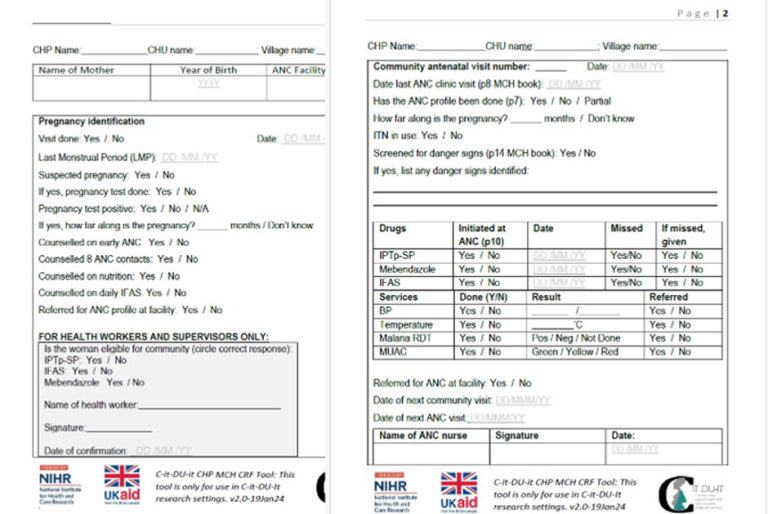
To complement this, we also adapted the widely used Mother–Child Booklet, creating the Community-Enhanced Mother-Child Booklet. Rather than altering its existing content, we simply added a dedicated section for Community Health Promoters to record household visits. This means that facility staff can view a woman’s full history at a glance. Both facility teams and community units report that this small adaptation has transformed coordination, improved trust, and saved time.
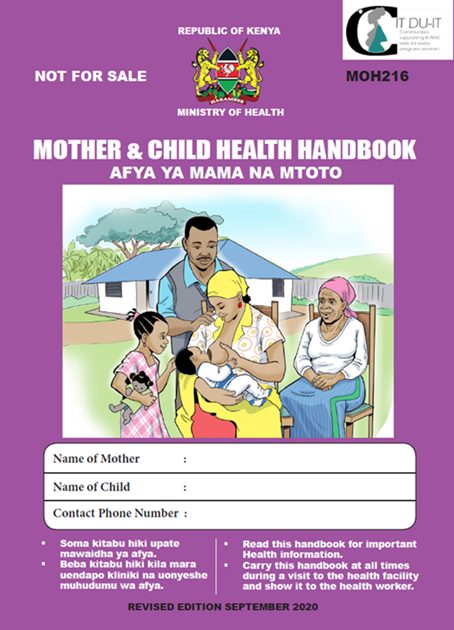
Cover Mother & Child Heath Handbook / LVCT HealthPages from the Community-Enhanced Mother-Child Booklet showing the dedicated section for Community Health Promoters to record household visits. / LVCT
The Impact
The adapted Mother-Child Booklet has quickly become more than just a record: it is seen as a silent supervisor, an accountability tool, and even a source of motivation for Community Health Promoters (CHPs). Nurses value being able to see at a glance who the CHP has already visited, while CHPs appreciate that their work is visible and recognized.
One CHP explained, “I ask the woman, ‘who is your CHP?’ then I text them. It helps us follow up.”
The Community Referral Form (CRF) section has become a practical way of communicating between the community and the clinic. It reduces duplication, ensures timely follow-up, and strengthens collaboration: “The CRF helps you to do the follow up … it is another way of supervision and appreciation.”
While a few challenges remain, such as women living with HIV not always wishing to share their booklet, the overall feedback is overwhelmingly positive. Health workers describe it as simple to use, not burdensome, and a tool that should continue even after the C-it DU-it project ends: “When C-it DU-it leaves, the CRF must remain … it should be adopted nationally!”
Through training and joint support, the CRF has given both CHPs and facility staff a stronger sense of connection, coordination, and purpose. As one CHP put it: “It is a motisha (motivation).”
The Way Forward
The strong endorsement from both CHPs and facility staff who repeatedly stressed that the CRF “must remain” and “should be adopted nationally” has caught the attention of county health managers. Building on this momentum, there is growing consensus that the adaptation should be scaled beyond the pilot counties.
At the same time, the electronic linkage is opening doors for a new era of seamless data use between communities and clinics, not only for ANC but also for wider maternal, newborn, and child health services.
By “seeing it” (C-it) and “doing it” (DU-it), we are making data work for mothers, babies, and health teams alike.
LVCT Health, in partnership with the Liverpool School of Tropical Medicine (LSTM) and the Kenya Medical Research Institute (KEMRI), recently advanced efforts to improve antenatal healthcare through the C-it DU-it Study in Homa Bay County.
Over a three-day consortium review meeting, Community Health Promoters (CHPs), health facility staff, and partners reflected on progress, share lessons, and explore opportunities for strengthening maternal healthcare delivery.
The discussions focused on what had been working well, the challenges encountered, and strategies to address them for better outcomes.
📊 Achievements to date include:
Over 6,500 pregnant women reached with improved antenatal care (ANC) services.
More than 420 CHPs trained and supported to strengthen linkages between communities and health facilities.
ANC attendance at targeted facilities increased by 28% in the last year.
Introduction of digital tools to link community and facility data, reducing delays in decision-making and follow-up care.
Strengthened referral systems, with over 1,200 mothers-to-be successfully referred for timely ANC and skilled delivery services.
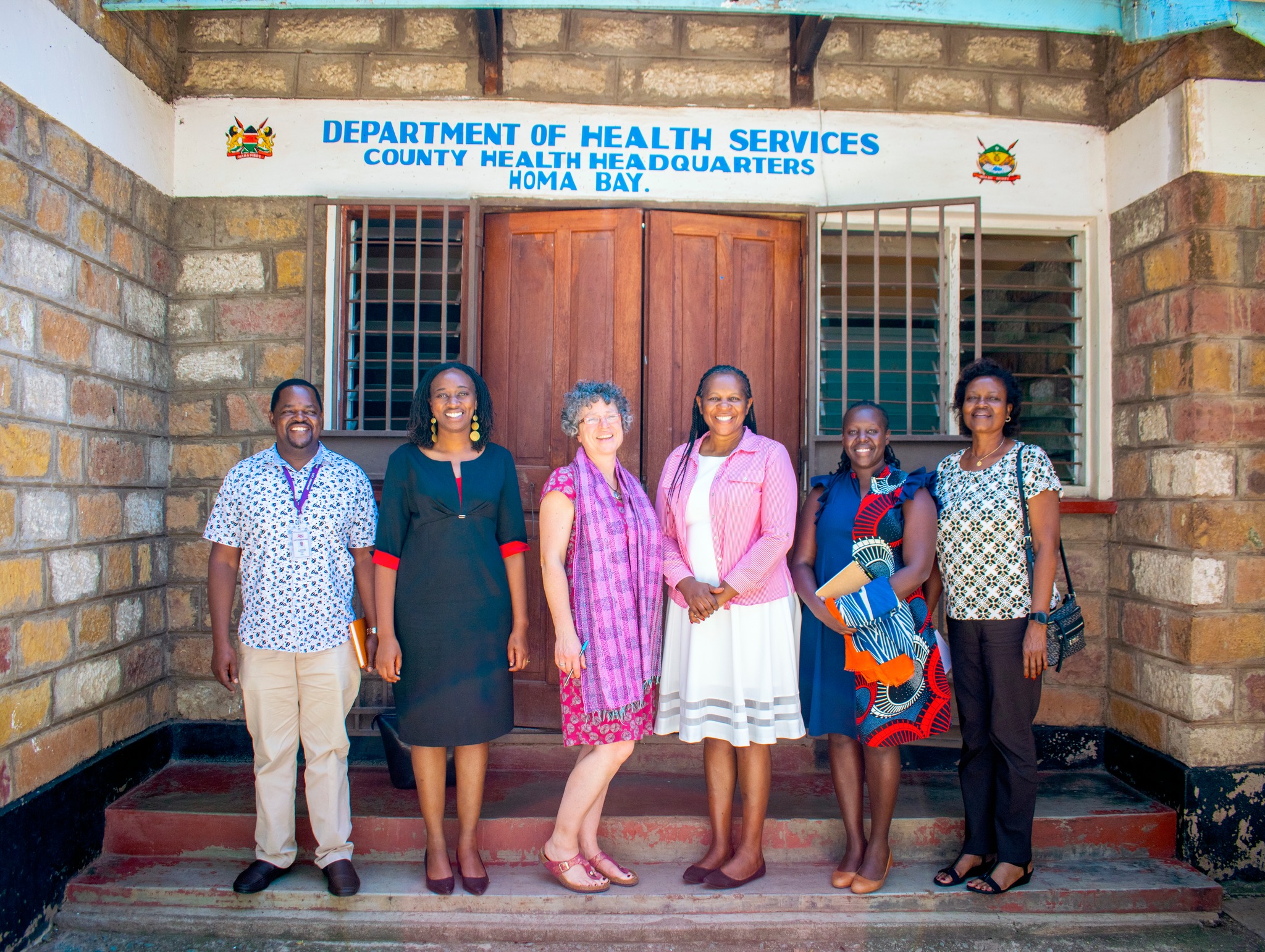
In a spirit of collaboration, the consortium also held a debrief session with Homa Bay County officials, led by the County Executive Committee Member (CECM) for Health Roseline Omollo. The session identified key areas for partnership and highlighted the county’s commitment to strengthening maternal health services.
Speaking during the session, Roseline Omollo noted that “Improving maternal health is at the heart of the county’s agenda. We are happy that this collaboration through the C-it DU-it Study is going to help us identify gaps, strengthen our systems, and ensure that mothers receive the care they need and deserve,”
The C-it DU-it Study, funded by NIHR through the Government of the United Kingdom, is a four-year initiative working in selected facilities across Homa Bay County. Its innovative approach centered on “seeing” linked data (C-it) and “doing” or acting on that data (DU-it) hopes to improve decision-making and responsiveness at both community and facility levels.
By enhancing community health systems and integrating services more effectively, the study seeks to strengthen community health systems by enhancing community and facility health components to improve Antenatal Care (ANC) outcomes by focusing on data quality from the community, so as to achieve the recommended eight ANC visits.
Together, LVCT Health and partners are laying the foundation for healthier communities, resilient health systems, and a brighter future for mothers and families in Homa Bay and beyond.
Welcome to my blog post on my week abroad in Kenya, studying community health and nutrition. I’m currently a year 12 student aspiring to study dietetics and nutrition. I’ve already taken up offers to shadow dietitians in primary healthcare and hospital settings in the UK.
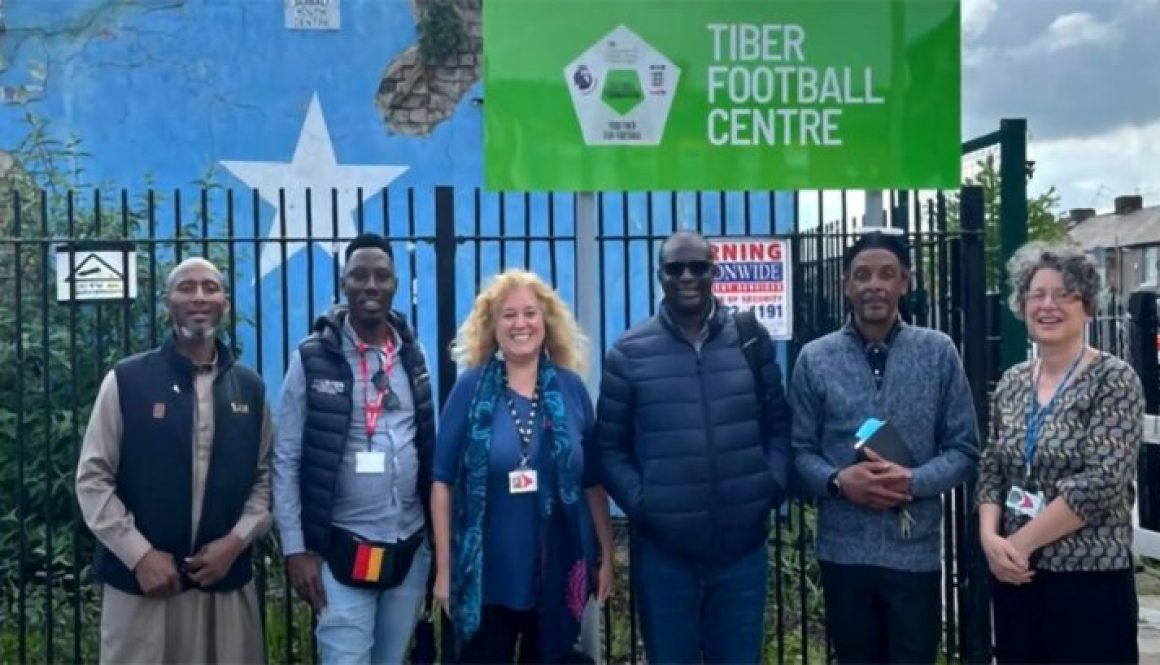
The Transforming the Community Health Workforce program is a unique mutual learning exchange between local government in Homa Bay County in Kenya and Liverpool, UK. Unlike traditional South-to-South collaborations, this initiative fosters South-to-North and North-to-South learning, enabling both regions to share knowledge and best practices. The exchange is jointly hosted by Liverpool School of Tropical Medicine (LSTM) and LVCT Health, a non-governmental organisation in Kenya.
Homa Bay County has a well-established community health program, while Liverpool has a long-standing Primary Care Network (PCN). As Kenya works to implement PCNs and Liverpool seeks to enhance its community health programs, this exchange provides a valuable opportunity to learn from each other’s successes and challenges.
The program pairs six professionals at different levels—from public health consultants to clinicians, community health leads, youth advocates, and those working with vulnerable groups—to create change-maker pairs. These individuals shadow one another, experiencing community engagement and healthcare delivery in a real-world setting rather than a classroom environment.
Insights Gained from Liverpool
During their visit to Liverpool, the Kenyan participants observed key aspects of the UK health system, including structured workforce planning and the integration of sports and arts into healthcare outreach. They saw firsthand how these strategies help engage young people and promote well-being. One participant reflected, “I just want to borrow these lessons and take them back home to implement with my team.”
Lessons from Kenya
Liverpool professionals visiting Kenya were deeply inspired by the country’s strong community engagement model, where community health workers play a vital role in mobilization and advocacy. Seeing these practices in action reinforced the importance of incorporating community feedback into healthcare services. As one participant noted, “Hearing about community health is one thing—seeing it in real life is completely different.”
The exchange also highlighted the shared vision between the two regions. One participant observed, “The dream of the Primary Care Network in Kenya is exactly what is happening in England. Every citizen should know where to go when they are sick.”
Building Sustainable Partnerships
Both teams left the exchange with a commitment to integrating their learnings into their healthcare strategies and systems. The shadowing experience was particularly impactful, with one participant describing it as “fantastic because it was so organic. We weren’t in a classroom; we were out in the field, truly experiencing each other’s work.”
Beyond this exchange, there is growing interest in future collaborations. Discussions are already underway to explore new projects and further embed these insights into Liverpool’s healthcare framework. “This is just the beginning,” one participant emphasized.
Through this initiative, the Liverpool-Homa Bay partnership has demonstrated the power of mutual learning in strengthening global health systems. By sharing experiences, adapting best practices, and fostering lasting relationships, both regions are taking meaningful steps toward improving healthcare delivery at community level.
The exchange program between the Liverpool School of Tropical Medicine (LSTM) and Homabay County in Kenya is a mutual exchange of community health professionals. The program is part of the UKAid funded THET Global Health Workforce Programme.
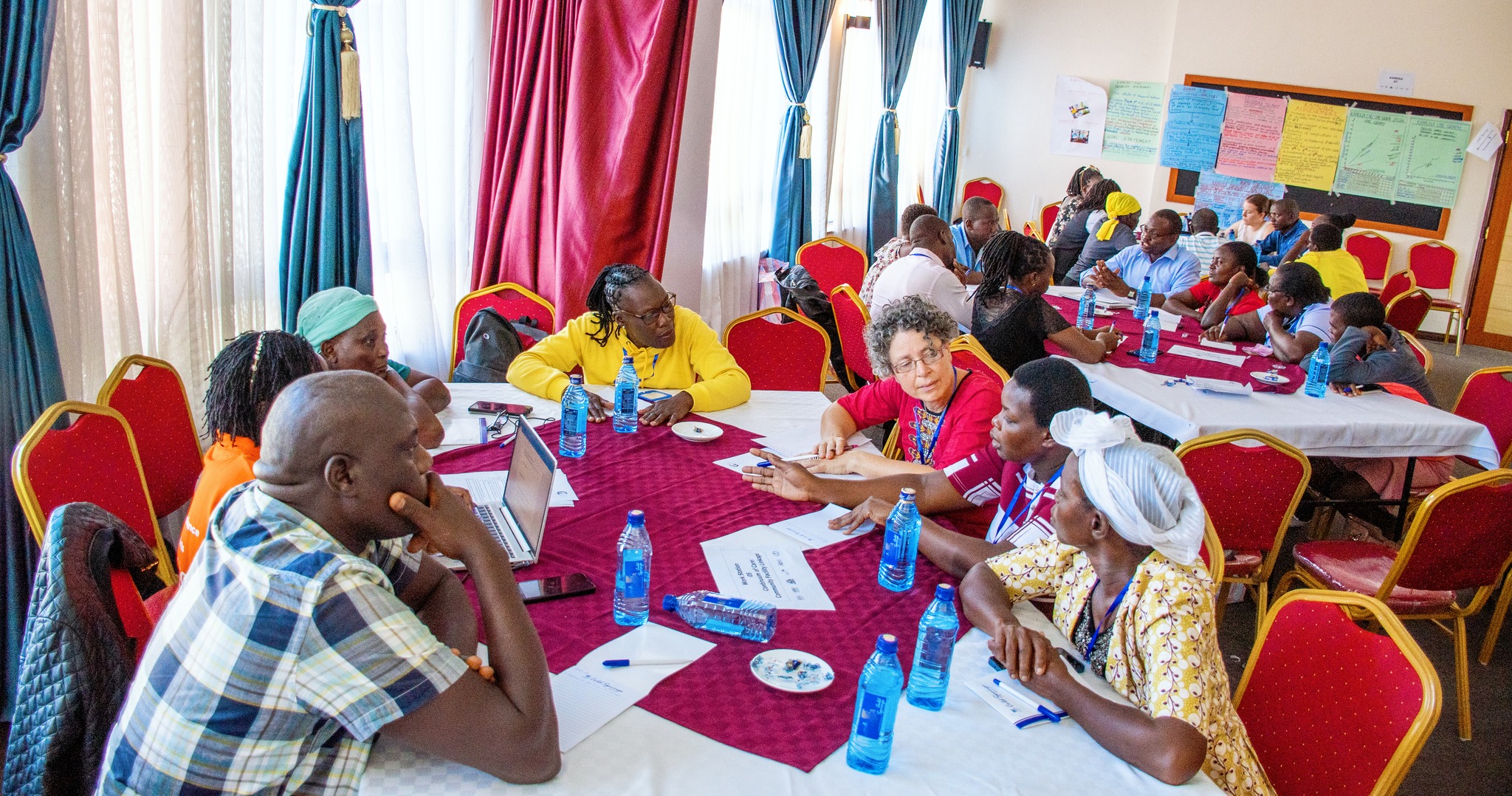
“C-it DU-it” (pronounced “see it; do it”) hosted its first Learning Event in Homa Bay in October 2024. This was the first time Homa Bay’s 16 Work Improvement Teams met to share innovations around early identification and referral of pregnant women. Nobody could ignore the palpable energy in the room as the Work Improvement Teams (WITs) arrived from all over Homa Bay. WITs displayed their hand-drawn posters, transforming the conference room into a huge talking wall. Representatives from all levels came to learn about community-led approaches to improving the uptake of antenatal care. The more than 130 participants included community leaders, adolescents, community health promoters (CHPs), community health assistants (CHAs), in-charges, sub-county and county representatives from Homa Bay, Migori and Kisumu, implementing partners, national leaders from the Community Health Division and the Department of Primary Health Care and international collaborators from Liverpool.
Get Access to Adult Video Telegram Link for Exclusive Content
If you are looking to find an adult video telegram link, you are stepping into a space where exclusive content is shared directly with users. These links provide access to a variety of adult videos that are often not available on regular platforms. By using an adult video telegram link, you can enjoy a wide range of videos in a private and secure environment. Telegram is known for its privacy features, making it a popular choice for sharing sensitive or exclusive content.
Using an adult video telegram link allows users to join channels or groups where new videos are uploaded regularly. This means you can stay updated with fresh content without the hassle of searching through multiple websites. The convenience of having direct access through Telegram makes it easier to explore different genres and categories of adult videos.
Moreover, the adult video telegram link often leads to communities where members can interact, share recommendations, and discuss their favorite content. This social aspect adds value beyond just watching videos, creating a more engaging experience. Whether you are new to Telegram or have used it before, finding the right adult video telegram link can enhance your viewing options significantly.
How to Join Adult Video Telegram Groups and Channels for Private Access
Joining adult video telegram link groups and channels gives you private access to exclusive content. These groups are part of larger adult video communities where members share and enjoy adult content safely. Many users look for adult group invites to enter these private adult telegram spaces, where adult content groups share new videos and updates regularly. Using adult content sharing links is the easiest way to find and join these communities without hassle.
Finding Reliable Adult Video Telegram Links and Invites
Finding trustworthy adult video telegram link invites is important to ensure you join safe and active groups. Look for adult group invites that come from verified or well-known sources within adult video communities. Avoid random or suspicious links to protect your privacy. Adult content groups often share adult content sharing links in forums or chats dedicated to these topics. Checking the activity level and member count of a group can help you find reliable private adult telegram channels.
Tip: Always verify the source of adult content sharing links before clicking to avoid scams or fake groups.
Steps to Join Private Adult Content Telegram Groups
Obtain a valid adult video telegram link from a trusted source.
Open the Telegram app and paste the link into the search bar or browser.
Click “Join” to become a member of the adult content group or channel.
Follow any group rules or guidelines to maintain access.
Engage with the community if allowed, or simply enjoy the content shared.
Joining these private adult telegram groups is straightforward once you have the correct adult group invites. Many adult video communities require approval, so be patient if your request is pending.
Tips for Safe Access to NSFW Telegram Links
Use a VPN to protect your identity when accessing adult video telegram link groups.
Avoid sharing personal information in adult content groups.
Regularly update your Telegram app to benefit from the latest security features.
Be cautious with adult content sharing links from unknown sources.
Report any suspicious activity within private adult telegram groups to moderators.
Categories and Types of Adult Content Available on Telegram
Telegram hosts a wide variety of spaces where adult content is shared, catering to different tastes and preferences. These spaces include groups and channels that focus on sharing various kinds of mature media. Users can find everything from videos to images and discussions, all organized in ways that make it easy to explore.
Many of these spaces are part of larger adult content communities, where members interact and share new material regularly. The content ranges from casual sharing to more explicit material, depending on the group’s focus. This diversity allows users to find exactly what interests them within the mature content telegram ecosystem.
The sharing of adult media on Telegram is often done through channels and groups that specialize in different types of content. This setup helps keep the content organized and accessible, making it easier for users to find what they want without sifting through unrelated posts.
Adult Video Sharing Groups and Communities
Adult video sharing groups are popular on Telegram because they provide a steady stream of new videos. These groups often have active members who contribute by posting fresh content and discussing the latest releases.
These communities focus on video content, making it simple for users to find clips and full-length videos.
Members can request specific types of videos or share recommendations.
The groups usually have rules to keep the sharing respectful and organized.
Example Features of Adult Video Sharing Groups:
Regular video uploads
User interaction and feedback
Categorized playlists or folders
Mature Content Telegram Channels for Various Interests
Mature content telegram channels cover a broad range of topics and interests beyond just videos. These channels might include photos, stories, or themed content that appeals to different audiences.
Channels often focus on specific niches or fetishes.
They provide curated content, which means the material is selected and organized by the channel owner.
Some channels offer exclusive content that can’t be found elsewhere.
These channels serve as a great way to explore different aspects of adult media sharing in a more controlled and curated environment.
Explicit Telegram Groups for Diverse Adult Media Sharing
Explicit telegram groups are known for sharing a wide variety of adult media, including images, videos, and sometimes live content. These groups tend to be more open about the type of material they share, often including content that is more graphic or intense.
They attract users looking for a broad selection of explicit content.
These groups usually have strict rules about privacy and sharing to protect members.
The diversity of content means users can find almost any type of adult media they are interested in.
Common Characteristics of Explicit Telegram Groups:
Main Features and Highlights of Adult Content Telegram Channels
Adult content telegram channels offer a unique way for users to enjoy and explore mature media. These channels provide easy adult content access, allowing members to view a variety of videos and images in one place. The channels are designed to support adult content sharing in a secure and organized manner, making it simple for users to find what they want without hassle.
One key feature is the variety of content available. From adult video channels that focus on streaming videos to groups that share different types of adult media telegram content, users can find many options tailored to their interests. The channels often update regularly, ensuring fresh material is always available.
Another highlight is the convenience of using Telegram for adult content. The platform supports large groups and channels, making it easy to join and participate in communities that share similar preferences. This setup encourages interaction and sharing while maintaining privacy and control over the content.
Benefits of Using Telegram for Adult Content Sharing
Telegram is popular for adult content sharing because it offers several advantages:
Privacy: Telegram’s encryption helps keep user activity confidential.
Ease of Use: Joining adult content telegram channels is simple with direct links.
Variety: Users can access many types of adult media telegram content in one place.
Community: Channels and groups foster interaction and sharing among members.
Regular Updates: Content is frequently refreshed, keeping the experience engaging.
List of Telegram Benefits for Adult Content Sharing:
Secure messaging and file sharing
Large file size support for videos
Ability to create private or public channels
Fast content delivery and notifications
Privacy and Security in Adult Media Telegram Groups
Privacy is a major concern when accessing adult media telegram groups. Telegram provides several features to protect users:
End-to-End Encryption: Keeps messages and shared content secure.
Anonymity: Users can join channels without revealing personal information.
Control: Admins can manage who joins and what content is shared.
Reporting Tools: Users can report inappropriate or suspicious activity.
Security Tips for Users:
Use strong passwords and two-factor authentication.
Avoid sharing personal details in groups.
Join channels from trusted sources only.
Regularly update the Telegram app for security patches.
These measures help ensure that adult content access remains safe and private for all members.
How Adult Video Access Links Enhance Content Discovery
Adult video access links play an important role in finding new and exclusive content on Telegram. These links provide direct entry points to specific adult video channels or groups, making it easier to discover fresh material without searching extensively.
Quick Access: Links lead straight to the desired content.
Exclusive Content: Some links grant entry to private or invite-only channels.
Organized Sharing: Channels often categorize videos for easy browsing.
Community Growth: Sharing links helps expand adult content telegram channels and their audiences.
Ways Access Links Improve Discovery:
Save time by avoiding random searches
Connect with niche or specialized content groups
Enable sharing of new videos among friends or communities
Keep users updated with the latest uploads through notifications
Using adult video access links is a convenient method to explore the wide range of adult media available on Telegram.
FAQ About Adult Video Telegram Links and Groups
Many people have questions about how adult content telegram groups work and how to use them safely. This FAQ will help explain common concerns about adult video access, adult group invites, and adult content sharing on Telegram. Understanding these basics can make your experience better and safer when joining adult content communities.
What Are Adult Video Telegram Links?
Adult video telegram links are special URLs that let you join groups or channels on Telegram where adult videos and other mature content are shared. These links give you direct access to private or public spaces where members can watch and download videos.
They connect users to adult content communities.
Often used for easy adult video access without searching.
Help people find adult group invites quickly.
Example:
If you get an adult video telegram link, clicking it will open Telegram and show you the group or channel ready to join.
Are Adult Content Telegram Channels Safe to Join?
Safety depends on the source of the adult group invites and how you use the groups. Some channels are well-managed with clear rules, while others might share risky or illegal content.
Always check if the group is active and has good reviews.
Avoid sharing personal info in adult content communities.
Use privacy tools like VPNs when accessing adult content telegram groups.
Safety Tips:
Join groups from trusted sources.
Don’t click on suspicious adult content sharing links.
Report any harmful behavior to Telegram moderators.
How Can I Find Legitimate Adult Group Invites on Telegram?
Finding real adult group invites can be tricky because many links are fake or unsafe. Here are some ways to find legitimate invites:
Look for recommendations from trusted adult content communities.
Use forums or chats where users share verified adult content sharing links.
Check the group’s member count and activity before joining.
Method
Description
Trusted Forums
Communities where users share safe invites
Verified Telegram Links
Links from well-known adult content telegram channels
User Reviews
Feedback from current members about group safety
Can I Share Adult Content on Telegram Without Risks?
Sharing adult content on Telegram is possible but comes with risks. Telegram allows adult content sharing in private groups, but you must follow rules to avoid problems.
Share only in groups that allow adult content.
Respect privacy and do not share others’ personal info.
Avoid posting illegal or copyrighted material.
Important:
Sharing adult content without permission can lead to bans or legal issues. Always be careful and responsible.
What Types of Adult Media Are Commonly Shared in These Groups?
Adult content communities on Telegram share many kinds of mature media, including:
Videos (clips, full-length)
Photos and images
Stories or text-based content
Live streams or interactive content in some groups
These groups often organize content by type or theme to make it easy for members to find what they want.
Common Media Types:
Adult video access for streaming or download
Photo galleries shared within adult content telegram channels
Themed content for different interests in adult content communities
This research is funded by the NIHR (GH 150178) using UK aid from the UK Government to support global health research. The views expressed in this publication are those of the author(s) and not necessarily those of the NIHR or the UK government.